




Five Core Technology Trends in Precision Mold Manufacturing
In industries such as consumer electronics, smart wearables and automotive parts that are iterating rapidly today, the level of precision plastic mold manufacturing directly determines product quality and market competitiveness. Having been deeply engaged in the mold field for 20 years, Haipenghui Precision Industry, combined with cutting-edge industry developments, has identified five core technology trends in current precision mold manufacturing.
1. High-Speed, High-Precision CNC Machining As product structures grow increasingly complex and wall thicknesses thinner, the machining precision required for mold cavities and cores has reached micron level. Imported high-speed CNC equipment (such as Fanuc, Makino, Mori Seiki) combined with high-rigidity tooling and intelligent path optimization algorithms enables single-setup, multi-face machining of mold components, greatly improving machining efficiency and dimensional consistency.
2. Mirror EDM and Surface Quality Control For deep narrow slots, thin-wall ribs and other features that CNC cannot directly machine, EDM remains an irreplaceable process. The current trend is to adopt precision EDM machines with powder-mixed processing technology and intelligent discharge control systems (such as Makino EDM), achieving mirror finishes below Ra0.1μm, reducing subsequent polishing steps, and improving mold life and product surface quality.
3. The Precision Limit of Slow-Wire Cutting Slow-wire EDM is the core method for machining precision blanking dies, irregular holes, small inserts and other key components. New-generation slow-wire machines (such as Sodick) combined with automatic wire threading and constant-temperature control systems can stably control machining precision within ±0.002mm, with surface roughness reaching Ra0.2μm, meeting the extreme dimensional and appearance requirements of high-end molds.
4. In-Process Inspection and Closed-Loop Quality Control Traditional post-machining inspection is gradually being replaced by in-process inspection. By integrating on-machine measurement systems into CNC and EDM equipment, combined with feedback from CMM and 2D measuring instruments, real-time adjustment of machining parameters forms a measure-feedback-compensate closed loop, ensuring mold component precision at the source and greatly reducing rework and trial molding cycles.
5. Mold Flow Analysis and Process Simulation During the development of new molds, using mold flow analysis software to perform virtual simulation of plastic filling, packing, cooling and warpage has become standard practice in the industry. By predicting potential defects such as uneven filling, sink marks, weld lines and deformation through simulation, gate locations, cooling channel designs and injection molding process parameters can be optimized before mold opening, significantly shortening trial molding cycles and improving first-trial success rates.
Conclusion Precision mold manufacturing is shifting from experience-driven to data-driven and intelligent control. Haipenghui Precision Industry will continue to track and apply the above core technologies, providing customers with mold solutions of higher precision, longer life and shorter lead times, helping customers gain an edge in fierce market competition.
Related News
-
Common Injection Molding Defects and Solutions
Industry News | 2026.07.30Learn More
-
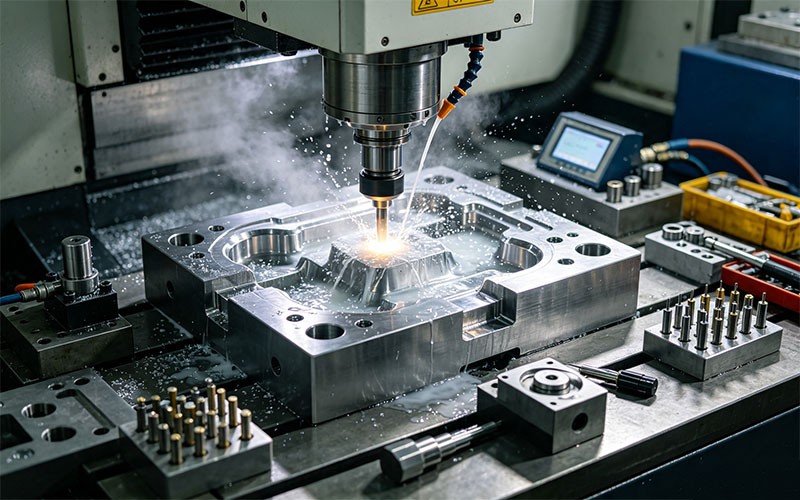
Five Core Technology Trends in Precision Mold Manufacturing
Industry News | 2026.07.30Learn More
-

Automotive Lightweighting Accelerates, Driving Rising Demand for Precision Plastic Molds
Industry News | 2026.07.30Learn More
-

Smart Wearable Market Continues to Heat Up, Ushering in New Growth for Precision Structural Parts
Industry News | 2026.07.30Learn More